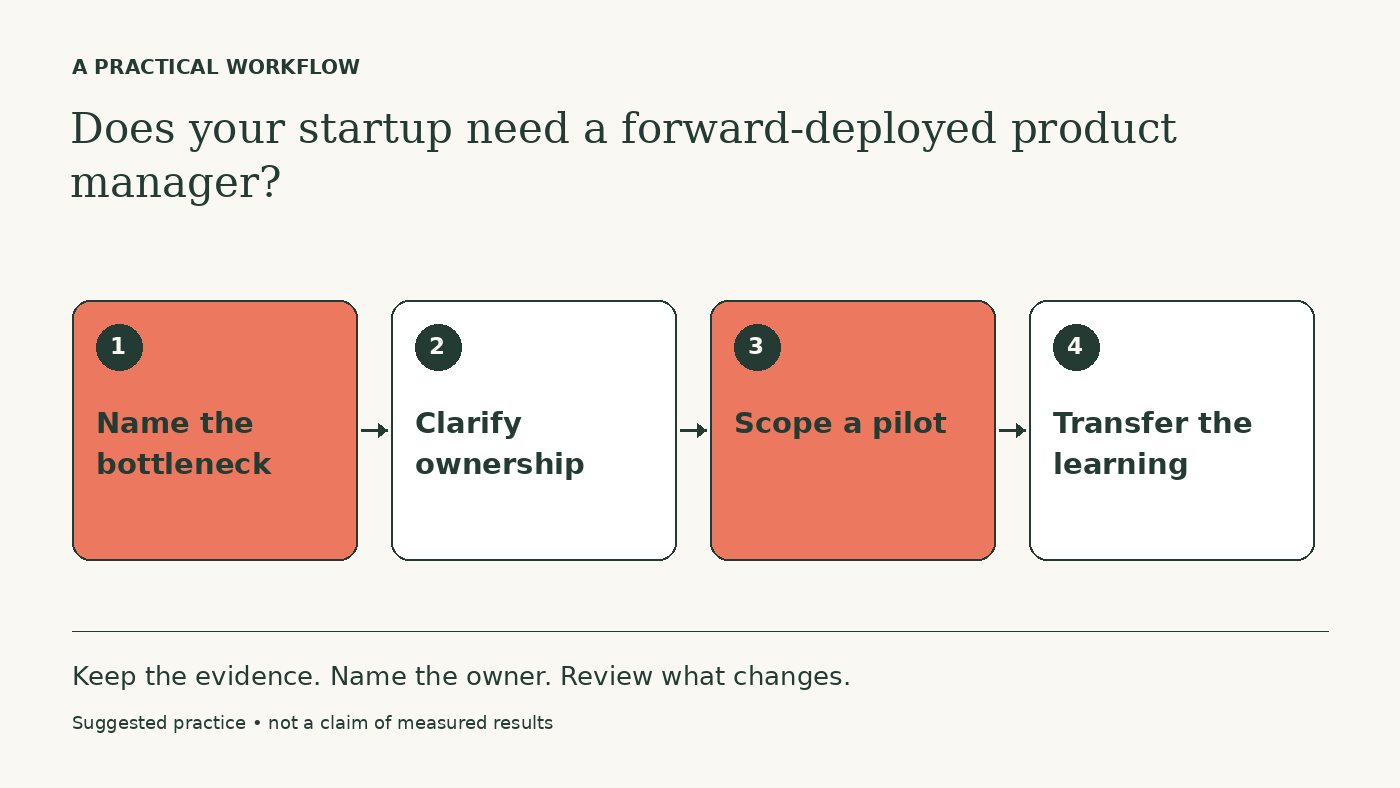
Original workflow diagram; suggested practice, not measured results.
Quick answer: Consider a forward-deployed PM when customer implementation exposes unresolved product tradeoffs and needs sustained outcome ownership. First identify the bottleneck and check whether a narrower role or process change would solve it.
A customer says they need a custom dashboard, a new integration, and a dedicated person who understands their business. For a startup, that request can be an opportunity to learn or the beginning of an expensive custom-services obligation.
A forward-deployed product manager can help interpret that situation. The title alone does not tell you whether you need one. Begin with the decision that remains unresolved and the work required to resolve it.
Diagnose the gap before choosing the title
If the desired behavior is clear but the integration is difficult, an engineer may be the right first addition. If users struggle to understand the workflow, design and research may be the gap. If teams disagree about which problem matters, what belongs in the product, or what success means, product judgment may be the constraint.
A forward-deployed PM works close to implementation while connecting customer learning to product decisions. Scale AI's role description is one example. Your early-stage company may need a narrower engagement and different authority than an enterprise deployment team.
Protect the core product
Write down which work is a supported configuration, a paid custom deliverable, or a candidate for the shared roadmap. Do this before promising dates. A design partner's enthusiasm does not establish demand across the market.
Keep a record of repeated needs across accounts. Ask whether the capability supports your intended customer and whether you can maintain it. A feature that wins one customer can still weaken the product if it creates a permanent exception nobody owns.
A worked example: the first enterprise pilot
Imagine a hypothetical scheduling startup whose enterprise pilot stalls. The buyer requests a management dashboard. Observation reveals that local managers cannot approve schedule changes under the customer's internal policy.
An embedded PM clarifies the approval outcome and the decision rights. Design explores a small approval flow. Engineering checks whether the existing permissions model supports it. The customer names an operational owner who can resolve policy questions.
The startup scopes a limited pilot instead of promising a complete dashboard. It agrees on the eligible teams, support responsibilities, and what evidence would justify broader product work. This is an illustrative approach, not a report of a customer result.
Write an engagement charter
- Outcome: the customer task or capability the pilot should improve.
- Authority: who can decide scope, product tradeoffs, and release readiness.
- Access: which users, systems, and evidence are available.
- Boundaries: excluded work and how new requests are assessed.
- Handoff: the owner of support, configuration, and reusable learning.
A hiring or contracting prompt
Evaluate this deployment situation: [context]. Separate product uncertainty, design uncertainty, integration work, and operating-policy issues. Suggest the responsibilities we need, the decisions each role should own, and a bounded pilot. Identify when a forward-deployed PM would add value and when a simpler arrangement would be enough. Do not assume a new hire is required.
Evaluate judgment with a work sample
Give candidates an anonymized scenario and ask how they would discover the problem, classify requests, and define success. Look for questions about evidence, constraints, and ownership. A polished roadmap produced before those questions is not necessarily a strong answer.
Compare this role with the designer-or-engineer hiring guide. The best addition is the one that addresses your actual bottleneck and leaves the company better able to serve the next customer.
Continue with a related guide
Questions you might be asking
Should a founder do this work before hiring?
Often the founder should understand the deployment problem first. Hire or contract when the scope and required expertise are clear enough to evaluate.
Is a forward-deployed PM a project manager?
They may coordinate delivery, but the distinctive responsibility should include product judgment and customer outcome decisions, with authority defined explicitly.
Sources and further reading
Sources checked October 16, 2026. Examples and suggested workflows are original teaching exercises.
AI workflow scorecard
Get the worksheet now, plus the occasional practical next step by email. No spam, unsubscribe any time.
Need a little help applying this? Explore coaching and implementation.