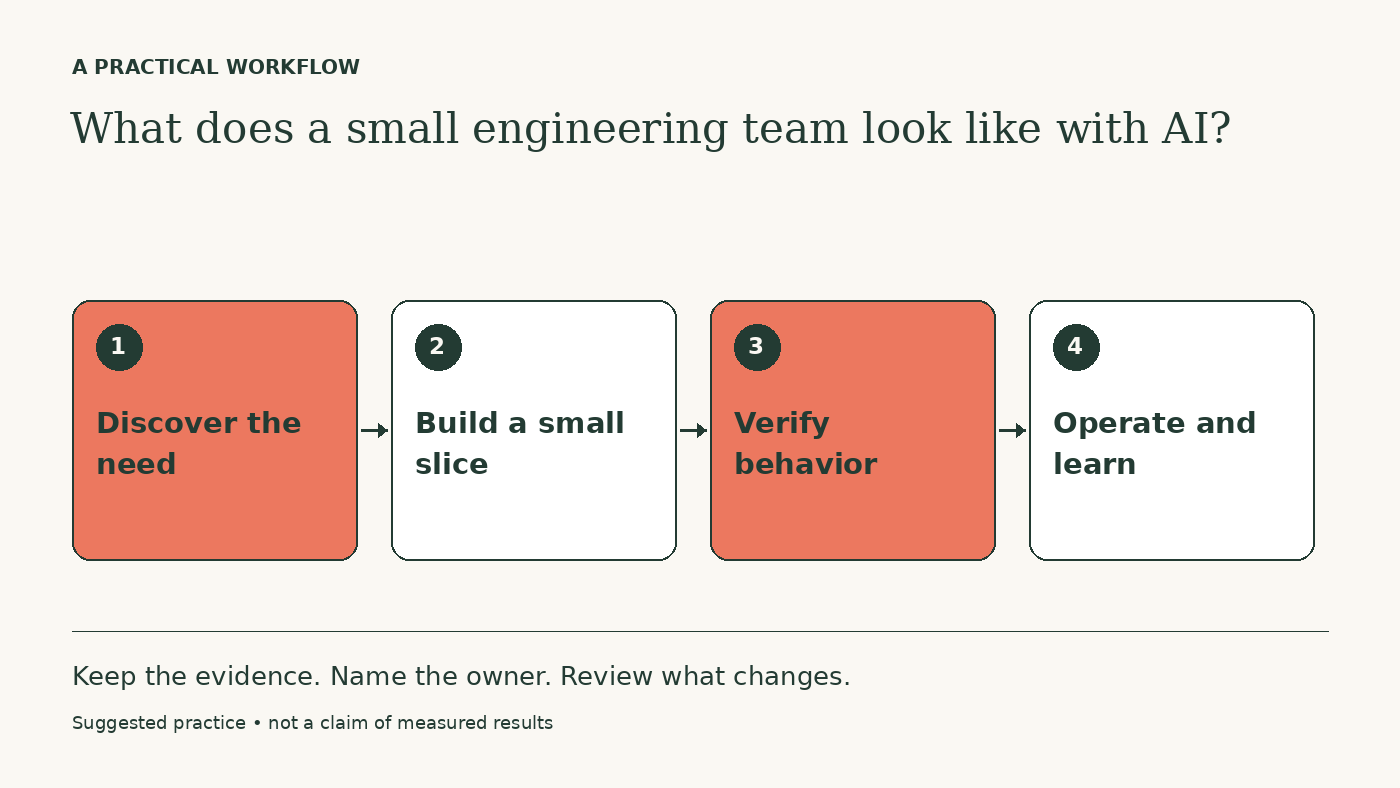
Original workflow diagram; suggested practice, not measured results.
Quick answer: A small AI-assisted team still needs ownership of customer understanding, architecture, implementation, quality, and operations. People may cover several responsibilities, but none should disappear from the plan.
There is no universal team size for an AI-era startup. A simple prototype, a customer-facing subscription product, and a system handling sensitive business operations require different skills and support. AI changes how some work is performed; it does not remove the need to know who owns it.
Start with responsibilities and risk. Then decide which responsibilities can reasonably sit with the same person and where you need another perspective or specialist help.
Cover the complete product lifecycle
Someone must understand the customer problem and choose priorities. Someone must design the interaction and inspect whether people can use it. Someone must implement and maintain the system. Someone must verify quality, and someone must respond when the product fails.
In a small team, one person may cover several of these areas. That is a staffing choice, not evidence that the responsibilities no longer exist. Write down the owner and the backup for each critical activity.
Use AI where the team can evaluate it
AI can help draft implementation plans, propose code, generate test cases, and explain unfamiliar sections of a codebase. An experienced person should inspect the result, run meaningful checks, and verify behavior in the actual environment.
Avoid measuring engineering value by generated lines or accepted suggestions. A short change that removes a customer obstacle may be more useful than a large feature. Include review time, defects, and maintenance when evaluating assistance.
A worked example: a first scheduling product
Imagine a hypothetical founder building a scheduling service. The founder handles customer interviews and product priorities. A senior engineer owns architecture and implementation. A designer helps with the booking and recovery flows. The team brings in additional expertise for unfamiliar security or operational decisions.
AI supports research organization, code drafts, and scenario checks. Before launch, the team tests time zones, duplicate submissions, cancellations, permissions, and failed notifications. It names a support owner and a way to disable a faulty change.
This is one illustrative staffing model, not a recommended headcount for every startup. A broader product or a less experienced team may need more support. A prototype with no real users may need less.
Agree on a useful definition of ready to release
A feature is ready when the intended behavior is verified, important failure paths are understood, and someone can operate it. Include documentation for the person who will maintain it. A successful AI-generated demo is a starting artifact, not proof of production readiness.
Keep changes small enough to review and reverse. If the review queue grows, stop generating additional work and address the bottleneck. Hiring another builder may not help when the missing capacity is evaluation or customer understanding.
A team-planning prompt
For this product and stage: [context], list the responsibilities needed for discovery, design, implementation, quality, release, support, and maintenance. Identify where one person can reasonably cover several areas and where expertise or independent review is needed. Suggest bounded AI assistance for each. Do not assume a productivity multiplier or remove a responsibility because code can be generated.
Plan for the month after launch
Reserve time for fixes, support, instrumentation, and learning. Ask who can explain the system if the main builder is unavailable. The strongest small team is not the one with the fewest people on a slide. It is the one that can build a useful product, understand its behavior, and keep its commitments to customers.
Continue with a related guide
Questions you might be asking
Can one person build a product with AI?
Sometimes, particularly for a bounded prototype. Running a dependable product still requires the necessary skills, review, support, and maintenance capacity.
Does AI mean I should hire fewer engineers?
Evaluate your product, risks, and complete delivery process. Tool use alone does not establish the right staffing level.
Sources and further reading
Sources checked October 16, 2026. Examples and suggested workflows are original teaching exercises.
AI workflow scorecard
Get the worksheet now, plus the occasional practical next step by email. No spam, unsubscribe any time.
Need a little help applying this? Explore coaching and implementation.