Should a startup hire a forward deployed designer or engineer?
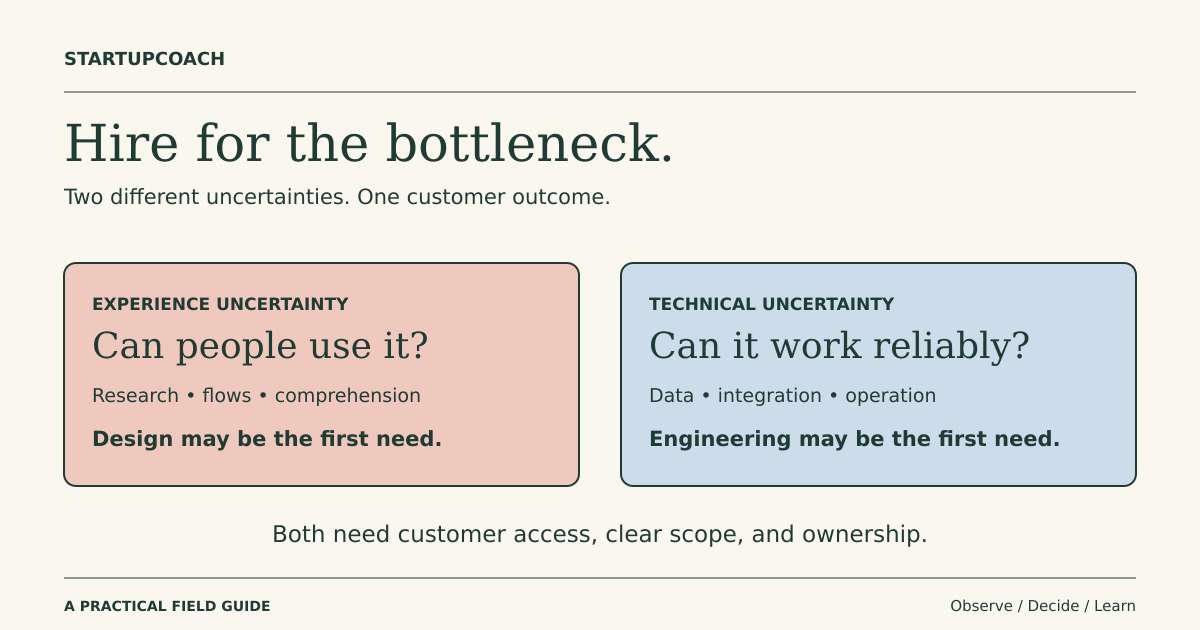
Choose based on the bottleneck. If customers cannot understand or complete a workflow, design and research may be the first need. If the workflow is understood but systems, data, or reliability prevent delivery, engineering may be the first need. When both are uncertain, pair the skills around a small customer problem before making a broad hiring commitment.
Forward deployed roles work close to customers and help make a product useful in their operating environment. The designer title is real but varies by employer. Tailor, for example, describes customer implementation design and reusable product patterns; Palantir describes forward deployed engineering in terms of technical and operational customer outcomes.
Start with a bottleneck memo
Write one page with five facts: the customer, the task, the current obstacle, the evidence, and the decision you need to make. If the memo says only “we need someone who can do AI,” the role is not ready to scope.
Illustrative example: a startup sells a scheduling tool to service businesses. Customers hesitate because staff cannot tell who owns a request after a change. The immediate question may be workflow design and responsibility. If the same customers cannot receive updates because an integration fails, the immediate question is technical delivery. Both matter, but they imply different work and review requirements.
Do not use a specialist to avoid founder discovery. Someone still needs to decide which customer matters, which problem the company will solve, and which requests it will decline.
Compare the options
| Situation | A useful first move | Evidence to request |
|---|---|---|
| The problem or buyer is unclear | Founder-led discovery with research support | Recent customer examples and a testable problem |
| Customers struggle with the experience | Bounded design engagement | Workflow analysis, tested alternatives, handoff quality |
| Data and systems block delivery | Engineering assessment or implementation | Integration approach, failure handling, maintainability |
| Deployments repeatedly need both | A paired customer-delivery capability | Working outcomes plus reusable product learning |
| The work is occasional and well defined | A scoped contractor or partner | Relevant work, availability, ownership boundaries |
This is a decision aid, not a universal staffing rule. A permanent role can make sense when the need is recurring and central to your business. A bounded engagement can help reveal the work before you design a full-time position.
Define the commercial model as well as the role
Customer-specific delivery consumes time. Estimate implementation effort, support obligations, and the ongoing cost of exceptions. Separate product revenue from paid services in your operating review so you can see what each customer relationship requires.
A company may deliberately combine software and services. The risk is accidentally promising a scalable product while depending on unpriced custom work. Decide what can be configured, what becomes reusable product capability, and what needs a separate scope.
The role should help the company learn these boundaries. It should not become a permanent mechanism for accepting every request from the loudest customer.
Evaluate candidates using realistic evidence
Review work that resembles your problem. Ask what the person personally owned, how they handled contradictory requests, what shipped, and what they would change now. For design, inspect edge cases and the rationale behind decisions. For engineering, inspect integration reasoning, operational reliability, and handoff.
A paid, bounded work sample can be useful when both sides agree the scope and rights. Avoid asking candidates to deliver valuable unpaid client work. A discussion of an existing portfolio or a short hypothetical problem can often reveal the judgment you need.
If production coding is expected, state that explicitly. “Technical designer” and “forward deployed” do not by themselves establish someone’s implementation depth or authority to deploy.
Create a first-engagement charter
Agree one workflow, one customer owner, and one review date. List access requirements, deliverables, exclusions, implementation reviewers, and the process for changing scope. Define what successful operation looks like and who owns support after the engagement.
Include a product-learning review: which findings should become standard behavior, configuration, documentation, or a declined request? Require evidence rather than a list of feature wishes. Use the design-partner pilot guide to make this learning loop concrete.
Signals that the role is helping
Look for shorter time to a useful customer outcome, fewer avoidable errors or handoffs, better-quality decisions, and patterns that reduce work on the next deployment. Interpret these alongside customer mix and product changes. A busier delivery team is not automatically a more effective one.
Set a stop or redesign condition. If users remain unavailable, scope expands without decisions, or every implementation stays completely bespoke, revisit the operating model. Adding headcount to an unresolved ownership problem may increase cost without resolving it.
Questions founders ask
Does an early startup need either role?
Not necessarily. Founders may do the work themselves with limited specialist support. Hire when the work and constraints justify it, not because another company has adopted the title.
Is forward deployed design only for enterprise software?
No, but complex customer workflows make the model easier to recognize. Customer-facing creative platforms also use the title. The relevant question is whether close collaboration improves delivery and reusable learning.
What should I do this week?
Write the bottleneck memo, review three recent customer cases, and identify the missing capability. Then use the free startup planner to turn that decision into a bounded next step.
Primary examples
Examples checked October 14, 2026. Hiring and engagement recommendations are StartupCoach editorial guidance, not a claim that the same organization model fits every company.
The one-page business plan
Get the worksheet now, plus the occasional practical next step by email. No spam, unsubscribe any time.
Need a little help applying this? Explore coaching and implementation.