What do forward deployed engineers and designers do?
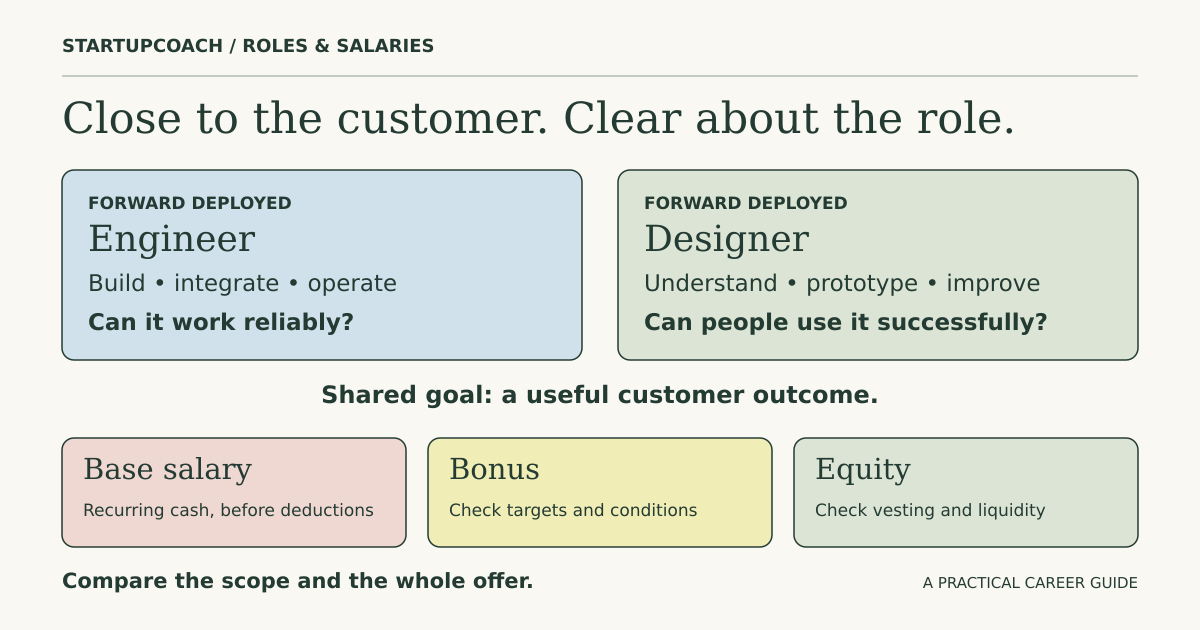
A forward deployed engineer works directly with customers to build, integrate, and operate software in their real environment. A forward deployed designer works directly with customers to understand their workflows and shape an experience they can successfully use. Both connect customer delivery with improvements to the underlying product.
The distinction is usually the responsibility each person carries. Engineering centers on technical execution and reliable operation. Design centers on the quality and usefulness of the experience. Strong teams share discovery, implementation feedback, and responsibility for customer outcomes.
The titles do not describe one standardized job. A design role might focus on enterprise software, brand creative, or customer education. An engineering role might focus on integrations, AI applications, or specialized systems. Read the actual scope before comparing salaries or deciding whether you are qualified.
What does a forward deployed engineer do day to day?
An FDE may meet a customer team to understand a problem, inspect the existing systems, decide what can be delivered, write and review code, build integrations, test failures, and help a solution reach production. They also explain technical tradeoffs and return recurring problems to the core product team.
For example, OpenAI's Seattle FDE role includes customer discovery, technical design, production delivery, and feedback to product and research. Its posting asks for production coding experience and measures impact through adoption and workflow results. This is an example of one employer's expectations, rather than a definition that applies to every FDE.
Typical work products can include an integration, a working application, an evaluation plan, deployment documentation, and an operational handoff. In an AI implementation, the work can also involve testing model behavior and deciding how the system should recover when an output is wrong or incomplete.
What does a forward deployed designer do day to day?
A designer may observe a customer workflow, facilitate a scoping session, map confusing handoffs, prototype alternatives, test comprehension, and review the delivered experience with engineers. Some roles also include training, creative production, and helping customers adopt a platform.
The employer examples show how broad the title can be. Tailor's product-design role connects customer implementations with reusable interface patterns. Hightouch's creative-design role focuses on brand creative, AI-assisted advertising workflows, and performance learning. Gamma's role combines customer design work with product education.
Typical work products can include a workflow map, interactive prototype, tested interface, creative system, quality criteria, and a reusable pattern. A polished presentation alone does not show whether the customer can use what was delivered.
How the two roles work together
Illustrative example: a business wants an AI assistant to help staff resolve customer inquiries. The designer studies the task, clarifies what staff need to see, prototypes the review flow, and tests whether people understand the assistant's limits. The engineer connects the necessary systems, implements permissions, builds the application, and tests reliability and recovery.
Together, they decide what a successful resolution means, inspect failures, and improve the workflow. Neither role should quietly inherit every responsibility for security, commercial strategy, support, and product management.
| Question | Forward deployed engineer | Forward deployed designer |
|---|---|---|
| Main focus | Can the solution work reliably in this environment? | Can people understand and use it successfully? |
| Core evidence | Working code, integrations, tests, operational results | Research, prototypes, design decisions, usability and adoption evidence |
| Customer interaction | Technical scoping, implementation, troubleshooting | Workflow discovery, co-design, evaluation, enablement |
| Product contribution | Reusable integrations, technical patterns, platform feedback | Reusable interaction or creative patterns, design-system feedback |
| Coding expectation | Usually substantial hands-on implementation | Varies: technical collaboration through production coding |
These are practical distinctions, not rigid boundaries. Check who owns implementation, approvals, rollout, and support in the specific job.
How much do forward deployed engineers make?
The following employer-posted examples show annual U.S. salary ranges in USD, with additional compensation separated. They are advertised hiring ranges checked on October 14, 2026, not verified employee earnings, national averages, or promised offers. This is not a live vacancy directory; confirm current openings and terms with each employer.
| Employer and exact role | Location and work model | Advertised annual salary | Additional compensation described |
|---|---|---|---|
| Palantir: Forward Deployed Engineer — Mixed Reality | Washington, D.C.; on-site | $135,000–$200,000 | Possible restricted stock units, sign-on bonus, and other incentives |
| Console: Forward Deployed Engineer | San Francisco; on-site | $180,000–$280,000 | Equity; the stated range excludes equity, benefits, and other incentives |
| OpenAI: Forward Deployed Engineer — Seattle | Seattle; hybrid | $185,000–$300,000 base pay | Equity and performance-related bonuses for eligible employees |
These positions have different demands. The Palantir example involves mixed reality and clearance eligibility; the OpenAI example requires travel up to 50%. A salary comparison should account for those conditions, location, seniority, and the work itself. The highest advertised endpoint is not an entry-level expectation.
How much do forward deployed designers make?
Design compensation also varies substantially by scope. These employer-posted examples use the same annual USD basis and review date. Hightouch advertises its role across North America; verify eligibility and the applicable offer terms directly.
| Employer and exact role | Location and work model | Advertised annual salary | Additional compensation described |
|---|---|---|---|
| Gamma: Forward Deployed Designer | San Francisco; in person 4–5 days a week | $100,000–$140,000 base pay | Equity and benefits |
| Tailor: Forward-Deployed Product Designer | U.S. remote role; approximately 10–20% travel | $130,000–$170,000 salary | Bonus and benefits |
| Hightouch: Forward Deployed Creative Designer, Ads | Remote, North America | $140,000–$180,000 base pay | Equity |
| Norm Ai: Forward Deployed Product Designer | New York City; hybrid, 3–4 days in office | $215,000–$265,000 base pay | Equity and benefits |
The Norm Ai posting describes Staff Product Designer responsibilities and asks for at least six years of product-design experience. Its range should not be presented as a starting salary for someone moving into the field. Gamma's posting spans multiple internal levels and asks for at least three years of design experience.
The ranges overlap with engineering examples. This small, selected sample does not establish which profession pays more overall. It does show why comparing the title alone can lead to the wrong conclusion.
Base salary, bonus, and equity are different things
Base salary is the stated recurring cash salary before taxes and deductions. Bonus may depend on individual or company performance, eligibility, and plan rules. A sign-on payment is generally a separate, one-time component and may have repayment conditions.
Equity is ownership-related compensation, such as options or restricted stock units. Its value and availability depend on the award terms, vesting, company value, and whether shares can be sold. A quoted equity value is not the same as spendable salary.
Illustrative offer comparison: $170,000 base plus a 10% target bonus produces $187,000 in annual cash only if the full $17,000 target is earned. A separate $80,000 equity grant vesting evenly over four years has a nominal annual allocation of $20,000; that does not guarantee $20,000 in cash each year. This example is invented for explanation and is not an offer from any employer listed above.
When comparing offers, ask for the base, target and maximum bonus, eligibility conditions, equity type, vesting schedule, travel expectations, and work location separately. For freelance or consulting work, compare scope and costs separately too: employee salary is not an appropriate substitute for a contractor's quoted rate.
Which role might fit your background?
If you have strong software delivery experience and enjoy working directly with customers, investigate engineering roles whose stack and implementation responsibilities match your evidence. If your strength is UX, product design, brand creative, research, or customer education, inspect the relevant design role rather than assuming every forward deployed designer does the same work.
For either path, prepare a case study showing the customer problem, your contribution, constraints, decisions, what shipped, and what changed. Label simulations clearly and avoid claiming business results you did not measure. Being comfortable with AI tools can support the work; it does not replace the role's underlying engineering or design requirements.
Questions people ask
Is forward deployed engineering just sales engineering?
Responsibilities can overlap, especially around demonstrations and technical discovery. Look for ownership after the sale: production implementation, adoption, and ongoing technical outcomes. The employer's scope matters more than the title.
Does forward deployed mean remote?
No. It describes working close to customer needs, not a work-from-home arrangement. The examples above include remote, hybrid, and on-site roles; some also require travel.
Can a forward deployed designer earn more than $200,000?
Yes, a specific example is Norm Ai's advertised $215,000–$265,000 base range for a role described at Staff Product Designer scope. That establishes an example, not a market-wide norm or a guaranteed offer.
Where should a founder start when hiring?
Identify the problem first, then match the role and budget to the required work. Continue with the founder's guide to choosing a forward deployed designer or engineer. If you are testing an embedded engagement, use the design-partner pilot guide to define boundaries and a review decision.
How these salary examples were selected
This article uses seven primary employer career pages linked beside their figures. It compares public full-time job advertisements, not individual payroll records. The sample is deliberately small, includes different levels and specialties, and is concentrated in U.S. technology employers. No average, median, or market-wide pay premium is calculated. Review the linked posting and written offer before making a career or hiring decision.
The role comparison, illustrative workflow, and offer-calculation example are StartupCoach editorial explanations. Salary figures and job-specific conditions come from the linked employers and were checked October 14, 2026.
The one-page business plan
Get the worksheet now, plus the occasional practical next step by email. No spam, unsubscribe any time.
Need a little help applying this? Explore coaching and implementation.