How do you find the first ten customers?
Start with a specific customer problem, identify people who already experience it, make a relevant invitation, and learn from the path between conversation and successful use. Keep a simple record of the evidence. The first ten customers are a useful learning target, not a guaranteed result or a requirement that every business should use the same channel.
Early acquisition is often partly manual. That can be appropriate when the founder still needs to understand the buyer and delivery. Paul Graham's Do Things that Don't Scale discusses this early recruiting work. The practical challenge is to make the manual work teach you what can later be repeated.
Define one customer situation
Replace a broad audience such as “small businesses” with a situation you can recognize: independent service providers who lose track of inquiries between an estimate and a booking. Identify the trigger, the current workaround, the consequence, and the person who can decide to buy.
This description is a hypothesis until you investigate it. Talk to people who recently experienced the situation. Ask them to describe what happened and what they tried. Questions about actual behavior are more useful than asking whether they would like a hypothetical product.
Do not assume a large problem automatically creates an accessible market. The customer may have no budget, a difficult approval process, a tolerable workaround, or more urgent priorities. Those facts belong in the acquisition plan.
Choose one primary route to conversations
| Route | When it may fit | What to watch |
|---|---|---|
| Warm introductions | A relevant existing network | Politeness mistaken for buying intent |
| Founder outreach | Recognizable prospects with a specific problem | Generic messages and poor targeting |
| A focused community | People already discuss the task | Community rules and earned trust |
| A referral partner | Another provider serves the same customer | Incentives, permissions, and lead quality |
| Search content or ads | Buyers actively look for a solution | Intent, cost, and the landing experience |
Choose based on access and buying behavior. Do not launch five channels just to appear active. A broad campaign can hide whether the customer, offer, message, or delivery is the actual problem.
Make a respectful, concrete invitation
Explain why the message is relevant, what problem you are investigating or helping with, and the small next step. Identify yourself honestly. Do not pretend to have researched someone's business if you have not, fabricate a mutual connection, or use misleading urgency.
Illustrative outreach structure: “I work on [specific problem] for [customer type]. I noticed [accurate, relevant context]. How are you currently handling [task]? If this is a priority, I can share [a concrete, truthful next step].” Adapt the wording to the relationship and channel; it is not a script to send indiscriminately.
Respect channel rules, applicable contact requirements, and requests to stop. The goal is a useful conversation with a suitable person, not the largest possible send count.
Make an offer someone can evaluate
Describe the outcome, scope, price or pricing conversation, timing, inputs needed, and what is excluded. If you are offering an early product, say what is ready. If delivery is manual, explain the service honestly rather than presenting it as a fully automated system.
For example, a bounded inquiry-review service can be evaluated more easily than “AI growth transformation.” The customer should understand what they receive and how they will judge whether it helped. Use the first-offer worksheet to turn a vague benefit into a clear exchange.
Track the transitions that teach you something
Keep a ledger with the customer situation, source, permission or context for contact, conversation date, main problem, offer made, decision, first useful outcome, and follow-up. Include a short reason for “not now” or “not a fit” when the person provides it.
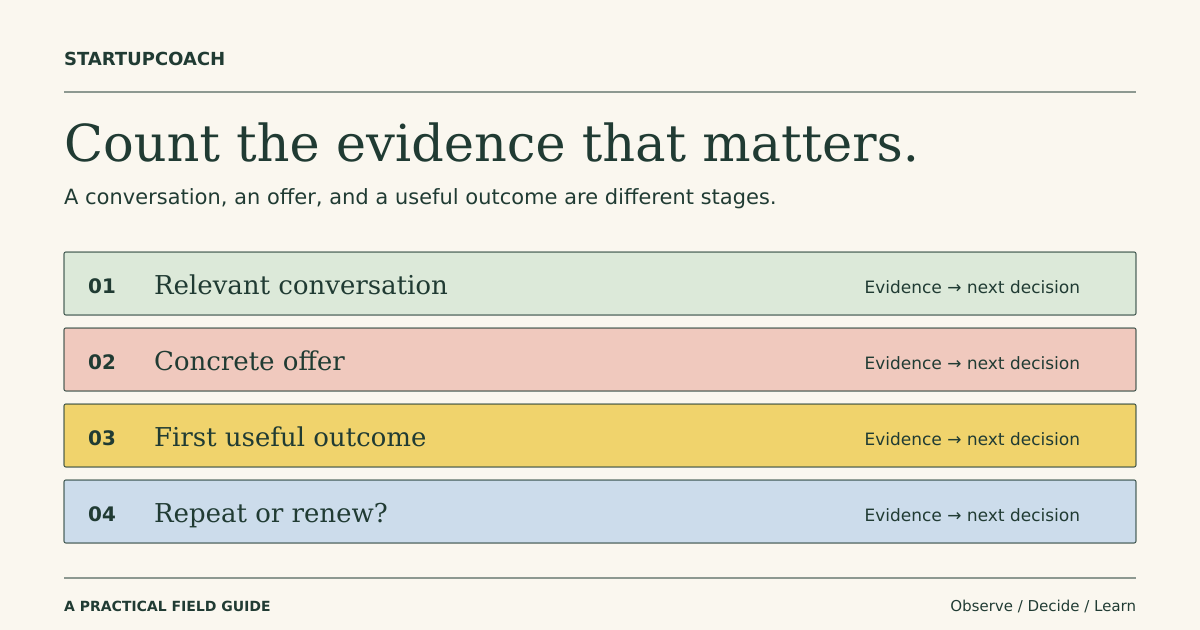
Use counts with definitions. A conversation is not a qualified opportunity; an accepted offer is not necessarily a paid order; a paid order is not proof of successful use. Record the stages separately so the team can see where the journey stops.
If conversations are relevant but offers are declined, inspect value, trust, timing, and terms. If offers are accepted but people fail to reach the first outcome, improve delivery before increasing traffic. If customers succeed but do not return, examine whether repeat use is appropriate for the business and whether the value persists.
A four-week learning cadence
In the first week, refine the customer situation and interview people with recent examples. In the second, test a clear offer with suitable prospects. In the third, help early customers reach the first useful outcome and document the work required. In the fourth, review the evidence and decide what to repeat, change, or stop.
The schedule is a planning aid. Some buying cycles are much longer. Set activity goals that fit your capacity, but do not treat them as promises of ten sales. Preserve enough time to deliver well to the people who do say yes.
Know when to add paid acquisition
Paid traffic can help test a clear offer, but it also amplifies unresolved problems. Before a campaign, define the intended conversion, verify the measurement, estimate what a customer can economically support, and agree a spending ceiling. A cheap click is not automatically a useful customer.
If each new customer needs substantial implementation, review the design-partner pilot guide. Acquisition and delivery need to grow together. For the broader sequence, start with the existing first-customer guide and the startup planner.
Questions founders ask
Should I offer everything for free at the beginning?
Not automatically. Free work can answer a product-use question while leaving willingness to pay unresolved. Decide what you need to learn and make the terms explicit.
What if people say the idea sounds great?
Ask what they do today, what would need to change, and what concrete next step they are willing to take. Treat praise as feedback, not revenue or a commitment.
What should I review every week?
Review the quality of conversations, the reasons for decisions, successful use, delivery effort, and the next assumption to test. Change one important part of the plan deliberately enough that you can learn from it.
Your first-customer plan
Get the worksheet now, plus the occasional practical next step by email. No spam, unsubscribe any time.
Need a little help applying this? Explore coaching and implementation.