A startup can generate more product ideas than it can evaluate. Agents can make that imbalance worse if they turn every suggestion into a task. The founder’s first responsibility is to decide which customer problem deserves the team’s attention.
Take a specific example: users abandon onboarding when asked to name a workspace. Before asking an agent to redesign the flow, establish what is actually happening. A support message, an event pattern, and a screen recording offer different kinds of evidence. None should automatically be treated as a complete explanation.
Write a problem brief with uncertainty intact
The brief should name the user, the step, the expected behavior, and the observed difficulty. Link the supporting evidence and record competing explanations. Perhaps the label is confusing. Perhaps the field rejects a valid name. Perhaps the preceding step is slow. Each explanation leads to a different intervention.
If the agent cannot reproduce a reported defect, it can still summarize the evidence and identify the next diagnostic step. That is useful investigative work. Calling an unreproduced problem fixed is not.
Define the smallest change worth reviewing
| Brief element | Example |
|---|---|
| User problem | A first-time user cannot tell what a workspace name is for |
| Proposed intervention | Add a short explanation and a concrete example |
| Acceptance criteria | Help text appears at the intended step and is readable on mobile |
| Regression concern | Existing validation and saved names still behave as intended |
| Evidence | Before and after captures, relevant check output, and a review note |
| Decision owner | Founder or designated product owner reviews release readiness |
This example assumes research supports a clarity problem. If investigation reveals a validation defect, change the brief. The purpose of the evidence is to influence the work, not decorate an idea that has already been chosen.
Assign investigation and implementation separately
Investigate the supplied onboarding issue and supporting evidence.
First describe the expected behavior and attempt to reproduce the problem.
Separate confirmed observations from possible causes.
If the proposed help-text change is supported, prepare it on a separate branch.
Keep the change limited to the agreed onboarding step.
Run checks appropriate to the change and inspect the mobile presentation.
Return the diff, evidence, check results, and unresolved questions.
Prepare a draft pull request where the integration supports it.
Leave merging, production data changes, and deployment for the release decision.
The wording deliberately allows a finding that the proposed fix is wrong. An agent that is required to implement the first idea may deliver exactly what was requested while failing to solve the customer’s problem.
Use a coding environment that can verify the work
Cursor documents isolated cloud development environments for its Cloud Agents. OpenAI documents Dot’s ability to use a previously configured Codex cloud environment. Either path needs the right repository and setup to do useful engineering work. Cursor Cloud Agents; Dot tasks and memory.
The proposed division of labor is straightforward: Dot tracks the goal and unresolved decisions; Work helps organize research and the product brief; a coding agent handles implementation; browser inspection checks the experience. This is an operating design, not a guarantee that all tools share files or sessions automatically.
Give every handoff the current brief and links to authoritative evidence. Do not assume a new task inherited every conversation. Decide who owns a file or branch before parallel work begins.
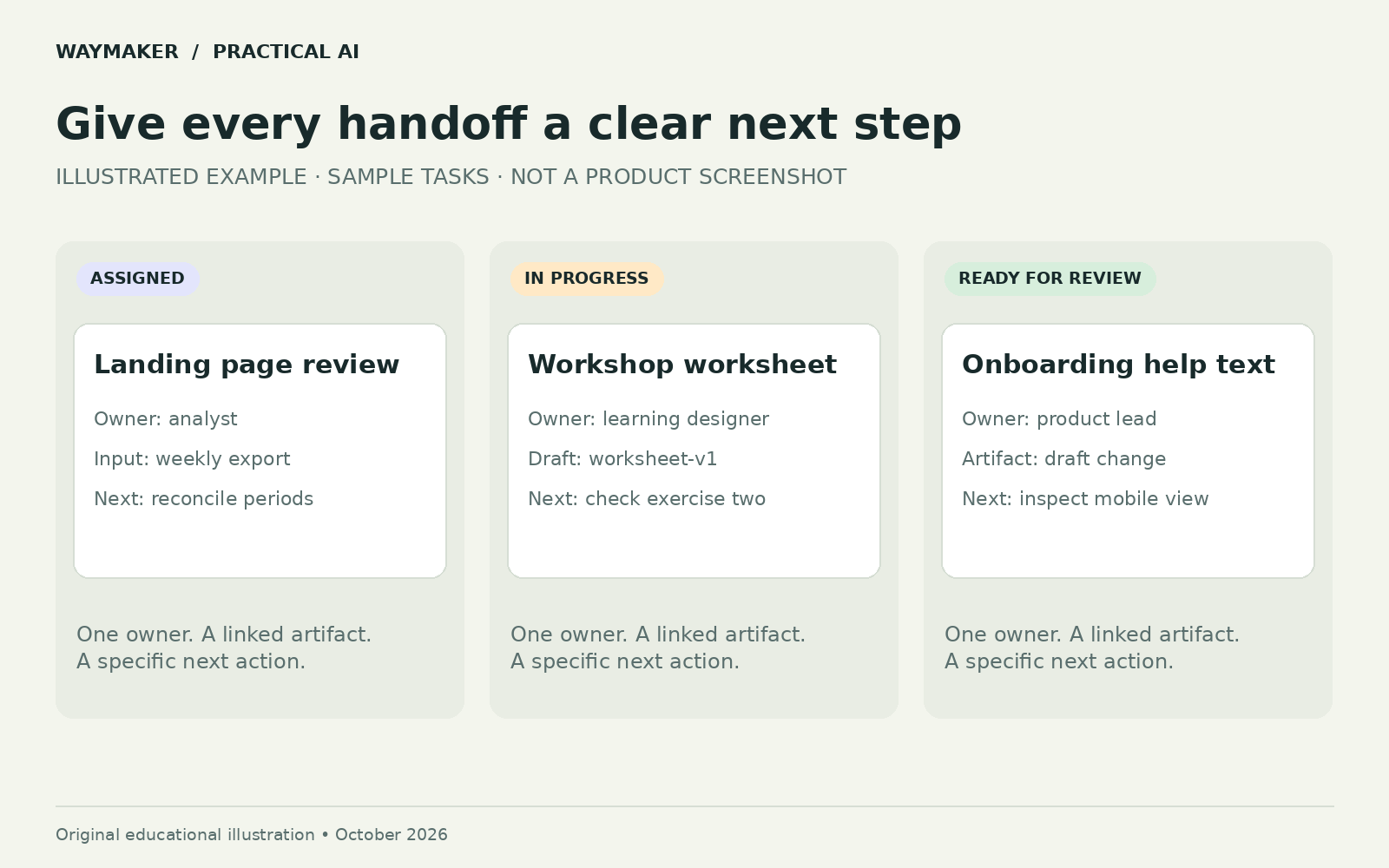
Original illustration with sample tasks. Each task has an owner, an artifact or input, and a next action.
Match the checks to the change
A validation fix may need a regression test that fails before the fix and passes afterward. A copy adjustment may be better checked through a focused build, accessibility inspection, and visual review. Avoid adding tests that merely restate the implementation without checking meaningful behavior.
If a test fails, record the command, relevant output, and whether the failure concerns the changed behavior. Do not remove an assertion simply to produce a green result. If the environment cannot run a required check, the handoff should name that gap.
Separate delivery evidence from business evidence
Passing tests show that specified checks passed. A screenshot shows the interface at a point in time. A deployed page shows that something was released. None of these alone proves that onboarding improved.
After release, evaluate the customer outcome using a defined measure and comparable data. A startup with little traffic may need moderated observation or direct customer feedback before it can interpret a conversion-rate change. State what you learned without claiming more certainty than the evidence supports.
Keep a decision record
Finish each change with a short note: problem, evidence, intervention, checks, release decision, and follow-up. If you revisit the same issue next month, this record will save time and make your product judgment easier to improve.
AI can shorten parts of investigation and implementation. The founder still chooses which problem is worth solving, what evidence is sufficient, and when a change is ready for customers. A good workflow makes those decisions clearer.
Explore practical founder support at StartupCoach and turn one customer problem into a focused delivery brief.
Companion guide: how Dot, Work, and browser access fit together.
The customer conversation kit
Get the worksheet now, plus the occasional practical next step by email. No spam, unsubscribe any time.
Need a little help applying this? Explore coaching and implementation.